


Good Day, this is the Commonwealth Report.
News for the public, not the powerful.
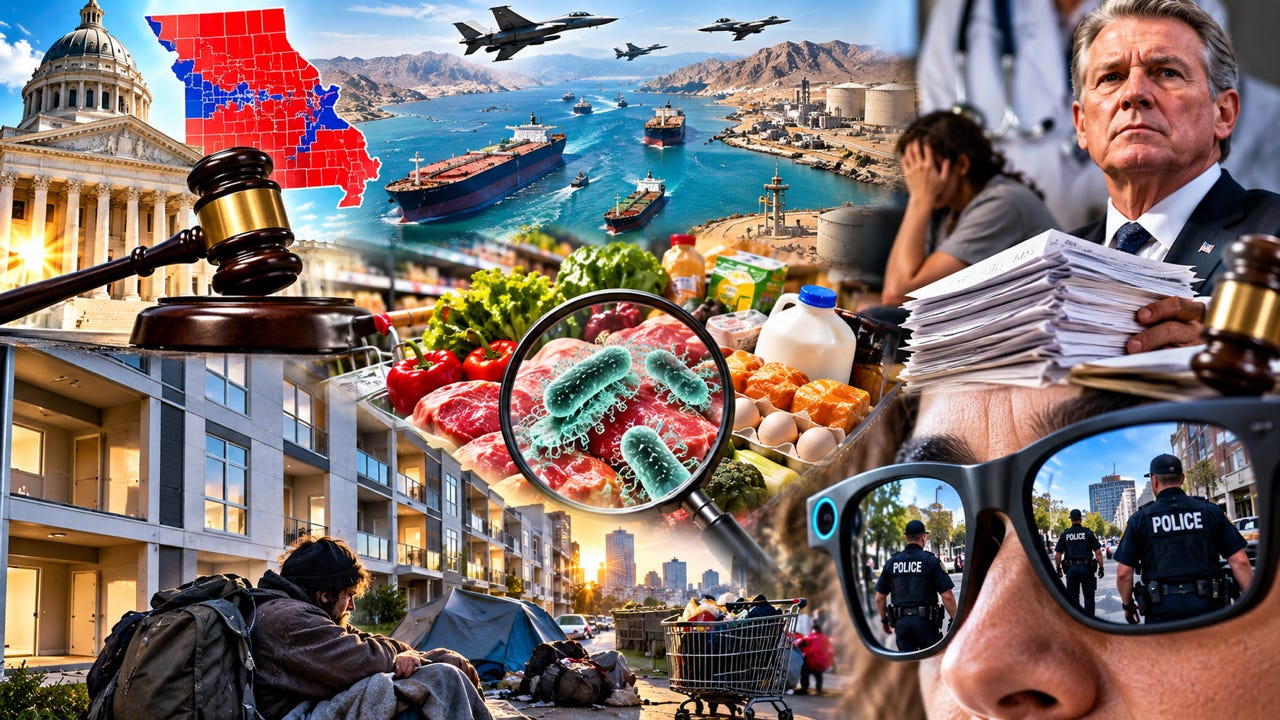
Will Missouri Republicans Defy Their Own Supreme Court to Keep a Rigged Map?
Missouri’s redistricting war just went from ugly to lawless. Last year, at Donald Trump’s urging, Republicans carved up Democratic Congressman Emanuel Cleaver’s Kansas City district to hand the GOP a 7 to 1 edge. That map already ran the August primary. Then last week the state’s own Supreme Court unanimously threw it out for November, restored the old lines, and sent it to voters as a referendum. Attorney General Catherine Hanaway lost her bid to pause that ruling, so she raced to Washington with an emergency appeal. And her own brief tells the justices that county election officials are now left to make their own decisions on whether to follow the state court or keep using the Republican map. Political reporter Mark Maxwell says that’s a signal officials could simply defy the court, “which would be absolute chaos.” A lawyer for People Not Politicians calls it open defiance. Candidates don’t know which district they’re running in. Cleaver, who’s represented Kansas City for 20 years, says he has no idea where he’ll land. The U.S. Supreme Court could act within days, with control of the House on the line. When a party treats court rulings as optional whenever it loses, that’s not redistricting. It’s the end of the rule of law.
Gulf Nations Build Walls Against Iran as Trump’s War Grinds On
Across the Persian Gulf, America’s allies have stopped waiting for Washington to finish this war. They’re building their own defenses and their own escape routes around the Strait of Hormuz. Officials gathered at the Hili Forum in Abu Dhabi this week said the region can’t keep living in a state of neither war nor peace. The UAE’s top diplomatic adviser, Anwar Gargash, put it plainly. He said “geography gives us no alternative to engagement” with Iran. Here’s what that looks like on the ground. The UAE has rushed a $3 billion pipeline to Fujairah, on the far side of the strait, and wants it online by mid 2027. Saudi Arabia is pushing oil to the Red Sea, where Iran’s Houthi allies are now attacking tankers. Iraq is working on pipelines through Turkey and Syria. And Gulf states are shopping for radar and missile defense systems, trying to knit their air defenses into one network. One Gulf official told reporters they’re Iran-proofing their economies. Think about what that means. The countries closest to this fight have concluded it won’t end soon, and they’re spending billions to live with it. That’s the bill for Trump’s war, and Americans are paying it at the gas pump and will continue too...
Who Gutted the Food Inspectors While Your Grocery Bill Kept Climbing?
The average American family now spends more than 10,000 dollars a year on groceries. Prices are up more than 18% since 2022, and two-thirds of Americans say they’re paying too much. Now Axios reports the food you’re overpaying for is getting less safe to eat. The FDA just hit a record 19 outbreak investigations running at the same time, covering everything from infant formula to jalapeños. Why? Because the Trump administration pushed out thousands of workers at the CDC, the FDA and the USDA, and federal officials admitted they’d do fewer inspections. Cornell economist Christopher Barrett says the idea that those cuts won’t hurt food safety is demonstrably false. When inspectors stop showing up, more contaminated product goes out the door, and companies pass the cost of recalls right back to you. Food and Water Watch analyst Lauren Borsheim says the administration “has really just dismantled many of the fundamental protections” that keep our food safe. Add corporate consolidation, where one supplier’s mistake becomes a multistate panic, like the Cyclospora outbreak tied to iceberg lettuce, and you’ve got a system built to fail. Inflation makes groceries hard to afford. Gutting the watchdogs makes them hard to trust. Working families are getting hit from all sides.
Did a GOP Senator Have His Own Patients Thrown in Jail Over Medical Bills?
Kansas Senator Roger Marshall spent 25 years as an obstetrician and brags on his website about his passion for the sanctity of life. Now the New York Times has gone through Kansas court records and found that Marshall sued more than 700 of his own patients over unpaid bills, some as small as 101 dollars. Eighty-one of them were arrested. Joe Vasquez and his wife were hauled off over Easter weekend in 2007, as they got ready for an egg hunt with their grandkids, over a $4,561 bill from her emergency hysterectomy. They spent two days in jail before relatives scraped together bail. Meischa Zimmerman owed $3,596 for an emergency C-section. It ballooned past $7,000. She was arrested in front of her 2-year-old. She said, “I asked them quietly, can you not handcuff me in front of my daughter?” Marshall’s worth up to $9.8 million. His spokeswoman says judges issue warrants, not doctors. Tell that to the mother who had to choose between her electric bill and $50 a month to a doctor who didn’t need it. This is what happens when we treat health care as a business instead of a right.
Why Are Thousands of “Affordable” Apartments Sitting Empty While People Sleep in Shelters?
Mathew Davis lives in a homeless shelter in Austin, Texas. He earns a few hundred dollars a month donating blood plasma. Even a $450 a month tiny home with no running water is out of reach. Meanwhile, more than 4,500 units Austin calls affordable, nearly 16 percent of them, sit empty. Here’s why. The federal Low Income Housing Tax Credit pays developers to keep rents low, but most of those units go to people earning 50 or 60 percent of the area’s median income. In Portland, a 60 percent unit rents for $1,444, barely below the $1,581 market rate. So the working poor skip the paperwork and rent market rate, and the poorest can’t afford either. Austin promised 20,000 units for its poorest residents. It built 543. Davis says, “I want to shut the door at night and be able to sleep.” There are 11 million extremely low-income renter households in America and only four million units they can afford. We’re subsidizing developers to build apartments nobody in a shelter can rent. That’s not a housing policy. That’s a giveaway with a nicer name.
Police Panic Over Meta Glasses That Let the Public Watch Them Back
And finally, the surveillance state has discovered it doesn’t like being surveilled. The Guardian obtained a dozen memos showing police from Maine to California are worried about Ray-Ban Meta smart glasses, the ones with tiny cameras and microphones. In January, the NYPD’s counterterrorism unit called them a security and counterintelligence threat and ordered officers to inspect all eyewear allowed in jail cells, after videos shot inside police facilities showed up on social media. Maine’s Homeland Security fusion center warned in June that the glasses can run facial recognition and could be used to dox officers. Similar memos came from fusion centers in San Diego, Tennessee, Virginia and New York. And in August, ICE banned its own employees from wearing them in federal workspaces, calling them the equivalent of body cameras. Ryan Shapiro of the transparency group Property of the People, which obtained the documents, put it perfectly. “When only the government is allowed to hold the camera, that’s not security.” That, he said, is impunity. These agencies run facial recognition on all of us every day. Turns out they only object to a camera when it’s pointed at them.
And that’s the way it is, Today Tuesday, September 8, 2026. I’m Thom Hartmann.


