


Good Day, this is the Commonwealth Report.
News for the public, not the powerful.
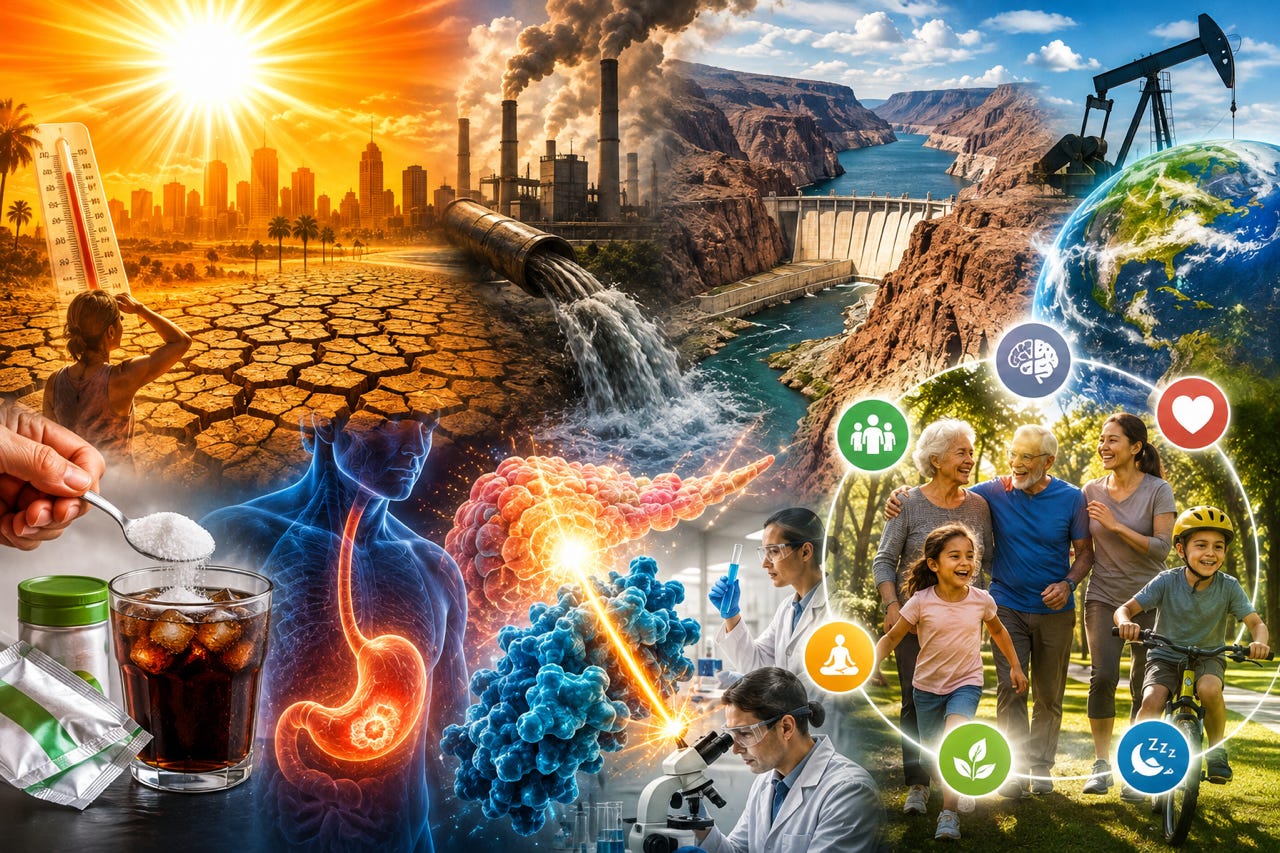
Did Climate Change Build This Heat Dome Over 80 Million Americans?
More than 80 million Americans are under an extreme heat warning or a heat advisory this week. Forecasters called this heat dome steamy even by late August standards. Record heat keeps punishing the South Central states and spreads into the Southwest by midweek, with highs well above 100 degrees and parts of Arizona and New Mexico topping 110. The heat index hits 105 to 115 across southern Arizona, Texas, Louisiana and northern Florida. The nights won’t cool down either, and that’s when the body is supposed to recover. Michael Wehner at Lawrence Berkeley National Laboratory says climate change has raised ordinary heat waves by “3 to 5 degrees Fahrenheit.” American heat waves have doubled since the 1980s. Heat already kills more people than hurricanes, wildfires and floods combined, and those deaths get undercounted. And Trump keeps cutting the very forecasters who warn us.
Big Oil Drained a Lake Mead’s Worth of Water From the West
Now we know who did it. A new study in Nature’s Communications Earth and Environment finds that 122 fossil fuel and cement companies are responsible for about half the water climate change has stolen from the American West. From 2014 to 2024, warming cut the region’s snowpack by more than a third and dropped streamflows 13%. The carbon majors’ share of that loss adds up to trillions of gallons, roughly the entire capacity of Lake Mead. In the lower Colorado River basin, streamflow fell 21%. Forty million people depend on that river. Co-author Carly Phillips of the Union of Concerned Scientists says the companies “engaged in a campaign of delay and denial and deception.” Cities and states are already suing. This study hands them the proof.
Is the Sweetener in Your Gum Raising Your Heart Attack Risk?
Xylitol shows up in sugar-free gum, candy, baked goods and toothpaste, and it’s sold as the safe choice. New research presented at the European Society of Cardiology Congress says otherwise. Researchers at Charité University Hospital in Berlin tracked roughly 17,000 people across Canadian and European studies. Among Canadian participants, those consuming the most xylitol had a 57% higher risk of a major cardiovascular event over six years. In the European group, the risk ran 18% higher over 30 years. Lead author Marco Witkowski says “further studies are warranted,” especially as product levels keep climbing. This is observational work, so it can’t prove cause. But regulators called these sweeteners safe decades ago and never went back to check while manufacturers kept increasing the doses.
Does a Daily Soda Really Triple Your Stomach Cancer Risk?
Mass General Brigham researchers followed 112,284 people in the Nurses’ Health Study and the Health Professionals Follow-Up Study for decades. People who drank at least one sugar-sweetened beverage a day had 2.45 times the risk of stomach cancer compared to people who drank less than one a month. Among women drinking more than one a day, the risk ran more than three times higher. Sodas, fruit punch, lemonade and sports drinks all counted. Diet sodas showed no link at all. Senior author Andrew Chan says the risk appears “meaningfully higher” for regular drinkers. Stomach cancer is still rare, and this is an association, not proof. But roughly 65% of American adults drink one of these every day, and the beverage industry spends millions making sure that doesn’t change.
FDA Approves a Pancreatic Cancer Breakthrough Priced at $39,800 a Month
For 40 years scientists called the KRAS gene undruggable. It drives more than 90% of pancreatic tumors, and the protein is so smooth that drugs slide right off. On Wednesday the FDA approved daraxonrasib, sold as Rasonque, a once-daily pill from Revolution Medicines. The FDA cleared it six and a half months early under a new expedited review, five weeks after the company filed. In a Phase 3 trial of 500 patients with metastatic pancreatic cancer, median survival went from 6.7 months on chemotherapy to 13.2 months on the pill. It cut the risk of death by 60%. MD Anderson’s Shubham Pant compared KRAS to “a shiny ball.” Here’s the catch. Revolution Medicines priced it at $39,800 for a 30-day supply. That’s a real medical breakthrough locked behind a price nobody without good insurance can touch.
What Happens When the Oceans, the Forests, and the Wheat All Break at Once?
Bill McKibben laid it out this week. The global sea surface just hit the hottest temperature ever recorded, and one Canadian scientist figures August 21st was likely the warmest ocean since the last Interglacial 125,000 years ago. Forty-two percent of the world’s ocean is in a marine heatwave right now. Coral is bleaching again, and reefs feed 500 million people. Out west, hot fires are turning conifer forests into shrubland for good. Studies say 40%of western conifers could be gone by 2100. Some western states get 75% of their water from snowmelt. And the wheat is failing. America is heading for its worst wheat harvest in 50 years. One new study says three degrees of warming could triple global wheat prices. McKibben’s point is simple. Politics is a subset of physics. You can lie about a lot of things. “But wheat is real.”
And that’s the way it is, Today Friday, August 28, 2026. I’m Thom Hartmann.


